
ServiceNow · ITSM
Enterprise Incident & Change Management
This anonymized ITSM case study covers a unified ServiceNow model for service restoration, problem investigation, controlled change and employee requests. Organization-specific details are withheld to respect the NDA.
Client organization not disclosed due to NDA
Client organization not disclosed due to NDA. Confidential details are generalized to protect the organization.
Business Problem & Objectives
Separate queues and inconsistent handoffs can make it difficult to assign work quickly, track service commitments and coordinate changes. The objectives were to standardise intake, make ownership visible, support reliable escalation and ensure changes receive appropriate review.
Solution & Architecture
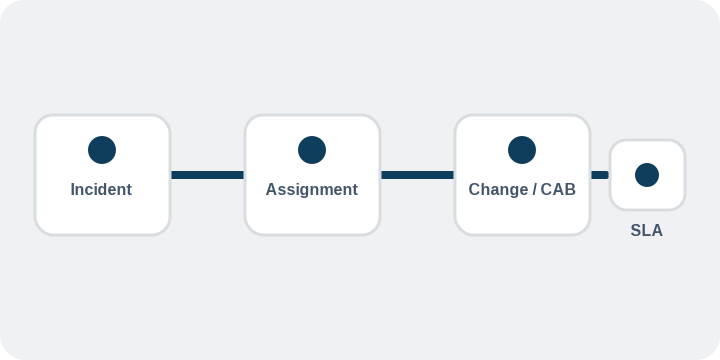
The solution centres on ITSM records and governed workflows. Assignment rules route work using service, category and support-group criteria; Flow Designer coordinates approvals and notifications, while business rules and client scripts support server-side integrity and user guidance. Client-specific details are generalized.
Generalized architecture
High-level workflow; client-specific details are generalized to respect the NDA.
Technologies & ServiceNow Capabilities
- Incident, Problem, Change and Request Management
- Flow Designer
- Assignment Rules
- Business Rules and Client Scripts
- SLA definitions, notifications and approvals
Implementation Approach & Workflow
- 1Capture and categorise an incident, problem, change or request.
- 2Apply assignment rules using the agreed service and support model.
- 3Track SLA milestones and trigger escalation notifications when thresholds are approached or breached.
- 4Route changes for CAB review and approval before implementation.
- 5Record fulfilment, communications and closure details for operational follow-through.
Key Features & Automations
- Auto-assignment with clear assignment criteria
- SLA tracking with escalation paths
- CAB approval and change-state controls
- Flow Designer orchestration for request and change steps
- Business Rules, Client Scripts and notification templates
Business Outcomes
- Standardised intake and ownership across incident, problem, change and request processes.
- SLA tracking and escalation paths for clearer visibility of service commitments.
- Structured change review and CAB approval workflows.